Photo Credit: AP Photo/John Locher
By: Gabby Toro-Rosa, Account Manager at Porter Novelli
Here is what changed at CES this year: Attendees arrived skeptical. They’ve seen enough over-hyped announcements to recognize marketing theater. So, the brands that broke through weren’t the ones who led with, “Look what we built.” They were the ones who said, “Come experience what this means.” They didn’t just show innovation, they invited people to participate in it.
This shift reveals something critical for communicators: The innovation story isn’t won at the announcement. It’s won through demonstration, participation and proof.
The Brands That Got It Right
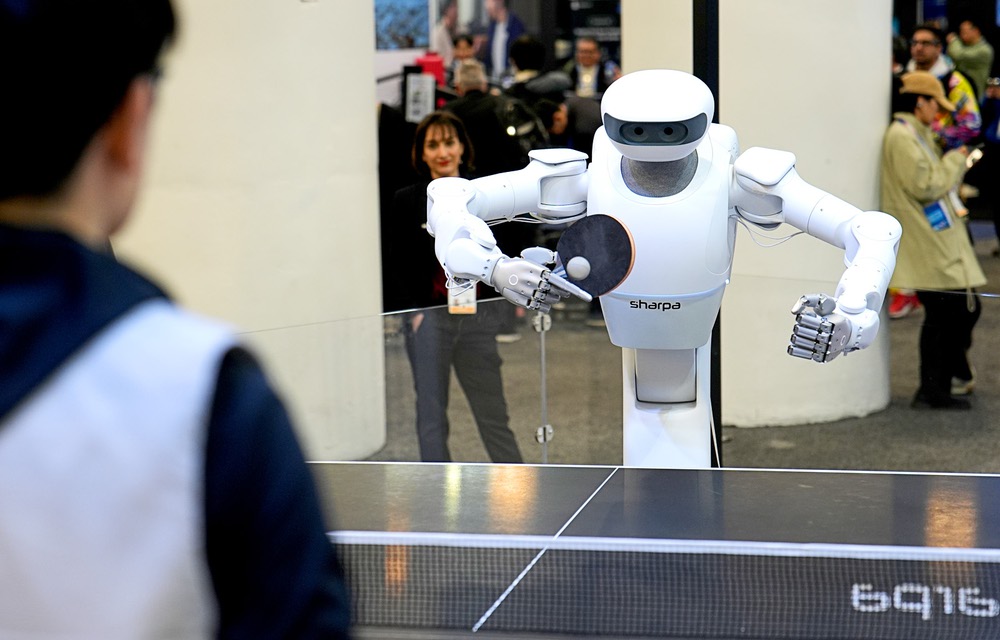
Sharpa. The AI robotics company could have buried the complexity of their robotic hand in technical specs. Instead, they challenged people to play ping pong against it with North, their first full-body robot. Attendees didn’t read about dexterity or hand-eye coordination. They felt it. They became active participants in proving what’s possible, not passive observers of a spec sheet.
Waymo. They introduced their 6th generation autonomous vehicle, but the story wasn’t about the sensors or the miles logged. It was about human experience and what it means to move through the world differently. They made safety and possibility tangible by letting people understand themselves inside the innovation, not outside looking in.
Doosan Bobcat. The heavy equipment industry is facing a worker shortage, and yet, they didn’t position automation as a replacement for people. They positioned AI as a democratizer, a tool that lowers the barrier to entry for new workers. The insight was about how people participate, not machines.
Razer. They reimagined human-AI interaction altogether. Their desktop hologram wasn’t framed as a product feature. Instead, it was framed as a shift in how we think about presence, interaction and ambient intelligence. They were asking people to imagine a different paradigm, not just adopt a device.
What This Means for Communicators
This isn’t just about better storytelling. It’s about rethinking how you structure the entire communication system around proof.
- Make skepticism your starting point. Your audience doesn’t want hype. They want to know what’s real, where it’s happening and what they can actually do with it. Structure your communication around answering these questions directly, not through marketing language, but through specific, verifiable examples.
- Move from announcement to experience. The media announcement matters far less than what happens next. Communicators need to design the experience for audiences to engage, experiment and discover value themselves. That might be a hands-on event, an interactive demo, a trial period or an immersive narrative. People believe what they experience.
- Communicate meaning over feature. The strongest communication at CES wasn’t about what the technology does. It was about what it enables humans to do differently. Identify the point at which your audience stops being an observer and becomes an active player in the story. Build your entire narrative around that moment.
- Prove it’s real. This means moving beyond vision statements. It means identifying concrete demonstrations, use cases and intermediaries that prove the innovation works. It means being specific about how someone can experience it themselves now rather than in the future.
- Don’t sugarcoat challenges. Every new advance comes with its benefits but also raises tough questions about long term impacts, disruption to the status quo, and potential inequities. Effective communicators lean into these complexities, so the innovator is the first voice helping make sense of the tension.
Communication Innovation has evolved beyond persuasion into proof. Our job as communicators isn’t to convince people the technology is real. That’s where trust begins and where behavior changes. And that’s where innovation actually gets adopted.
The brands winning understand this. The communicators who will win next are the ones who design for participation.